
Dermatology compounding pharmacy: custom creams, gels, and prescription options
- Published by Kevin Patel
- on November 20, 2026
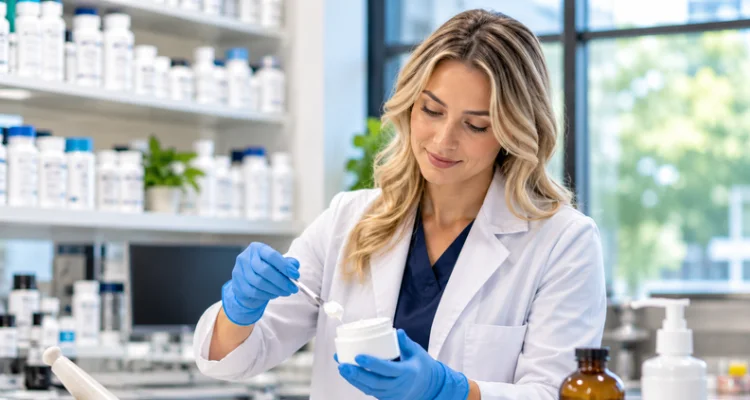
A compounding pharmacy can prepare dermatology medications in custom strengths, combinations, and bases that commercial manufacturers do not offer. For patients whose skin does not respond to standard products or who react to inactive ingredients in mass-produced formulations, Compounding can give prescribers additional formulation options when a commercially available product is not suitable for an individual patient’s prescription needs.
Skin conditions range widely, from chronic eczema and psoriasis to acne scarring, fungal infections, and hyperpigmentation. The right medication often depends on more than just the active ingredient. The base it sits in, the concentration a provider chooses, and whether certain dyes, fragrances, or preservatives are included all affect how well the treatment works and how the patient tolerates it.
At Bethelview Pharmacy in Cumming, GA, owner and pharmacist Kevin Patel, PharmD, RPh, works directly with dermatologists, primary care providers, and patients across Forsyth County to compound dermatology prescriptions in the exact strength, form, and formulation each patient needs. This guide covers what dermatology compounding involves, which conditions benefit from it, how compounded products differ from commercial alternatives, and what patients should expect.
Key takeaways
- Custom formulations: A compounding pharmacy prepares dermatology medications in strengths, combinations, and bases tailored to each patient’s specific prescription.
- Ingredient control: Compounded preparations can exclude dyes, fragrances, parabens, alcohol, and other inactive ingredients that irritate sensitive skin.
- Combination therapies: Prescribers can combine multiple active ingredients into a single cream or gel, reducing the number of products a patient needs to apply.
- Multiple dosage forms: Dermatology compounds can be prepared as creams, ointments, gels, foams, solutions, or sprays depending on the treatment area and patient preference.
- Discontinued medication access: When a commercial dermatology product is discontinued or on backorder, a compounding pharmacy can often prepare a replacement using the same active ingredient.
- Provider-driven treatment: Every compounded dermatology medication requires a valid prescription. The pharmacist works with the prescriber to confirm the formulation matches the treatment plan.
- Transparent pricing: Bethelview Pharmacy offers clear self-pay pricing for compounded dermatology prescriptions when insurance does not cover them.
- Local access in Forsyth County: Patients in Cumming and surrounding areas can access compounded dermatology treatments locally with prescription delivery options available.
What skin conditions benefit from compounded medications?
Dermatology compounding may be considered when a prescribed strength, dosage form, ingredient profile or combination is not available in a suitable commercial product.
Eczema and dermatitis
Patients with chronic eczema or contact dermatitis often need topical corticosteroids or calcineurin inhibitors in specific strengths that commercial products do not cover. A compounding pharmacy can prepare these medications in bases that avoid common irritants like alcohol, propylene glycol, or fragrances, which can worsen already inflamed skin.
Psoriasis
Psoriasis treatment frequently involves combination therapy. A prescriber might order a topical that combines a corticosteroid with a vitamin D analog, a keratolytic agent like salicylic acid, or coal tar in one preparation. Compounding allows all of these to go into a single application instead of requiring the patient to layer multiple products.
Acne and acne scarring
Commercial acne products come in fixed strengths that may be too strong or too weak for certain patients. A compounding pharmacy can prepare topical antibiotics, retinoids, or azelaic acid at the exact concentration a dermatologist prescribes. For patients who react to the alcohol base in many commercial acne gels, a compounded version can use an alcohol-free alternative.
Fungal infections
Antifungal medications for skin and nail infections can be compounded in higher concentrations than commercially available products or in penetrating bases designed to improve absorption through thickened or damaged nails.
Hyperpigmentation and melasma
Compounded preparations for hyperpigmentation often combine hydroquinone, tretinoin, and a mild corticosteroid in one formula. This type of combination cream is not available as a standard commercial product in every strength a provider might want to prescribe.
Dealing with a skin condition that has not responded well to over-the-counter or standard prescription options? Our pharmacist team can discuss what compounded alternatives may be available for your prescription. Contact our pharmacist team.
How do compounded dermatology medications differ from commercial products?
The core differences come down to customization, ingredient control, and form flexibility.
| Feature | Commercial dermatology products | Compounded dermatology medications |
|---|---|---|
| Strengths available | Fixed by manufacturer (e.g., 0.025%, 0.05%, 0.1%) | Any strength the prescriber orders |
| Combination products | Limited to manufacturer-made combinations | Multiple active ingredients combined per prescription |
| Base and vehicle | Fixed by manufacturer | Customizable (cream, ointment, gel, foam, solution, spray) |
| Inactive ingredients | Fixed by manufacturer | Adjustable (can remove dyes, fragrances, parabens, alcohol) |
| Availability | Subject to manufacturer supply and backorders | Compounded from raw ingredients on demand |
| Dosing flexibility | Fixed dose increments | Any concentration the provider prescribes |
| Prescription required | Some OTC, most Rx | Prescription required for all compounded formulations |
For patients who have tried commercial products without success, or who experience irritation from the inactive ingredients in standard formulations, compounded alternatives offer a level of flexibility that manufactured products cannot match. This is similar to how hair growth compounding addresses the limitations of fixed-dose commercial hair loss products.
What dosage forms are available for compounded dermatology treatments?
The dosage form matters in dermatology because it affects how well the active ingredient is absorbed, how comfortable the product feels on the skin, and whether the patient will use it consistently.
Creams
Creams are the most commonly prescribed form for dermatology compounding. They absorb well, spread easily, and work for most body areas. A compounding pharmacy can prepare creams in a range of bases, from lightweight vanishing creams to heavier moisturizing formulas, depending on the treatment area and skin type.
Ointments
Ointments provide a thicker, more occlusive barrier that holds the active ingredient against the skin longer. They are often preferred for dry, thickened, or scaly conditions like psoriasis. Some patients find ointments too greasy for daytime use, so a prescriber may order an ointment for overnight application and a cream for daytime.
Gels
Gels are lighter than creams and dry quickly, making them a good option for hairy areas like the scalp or for patients who dislike the feel of creams. They can be formulated without alcohol for patients who experience stinging or irritation from alcohol-based commercial gels.
Foams and sprays
Foam and spray formulations allow for easy, hands-free application to large treatment areas or hard-to-reach spots like the back. These forms are also useful for patients with conditions on the scalp where creams and ointments can mat down hair.
Not sure which formulation would work best for your skin condition? Our pharmacist team works with your provider to determine the right base, strength, and form. Contact our pharmacist team.
Solutions and washes
Medicated solutions and washes can be compounded for conditions that cover large surface areas or for use in skin folds where creams might be too thick. The pharmacist selects a vehicle that delivers the active ingredient effectively while feeling comfortable on the patient’s skin. This type of dosage-form flexibility is similar to how compounding addresses delivery preferences in hormone therapy and pain management.
How can dermatology compounding address ingredient sensitivities?
Ingredient sensitivity is one of the most common reasons patients are referred to a compounding pharmacy for dermatology prescriptions. Many commercial topical medications contain inactive ingredients that can trigger allergic reactions, irritation, or worsening of existing skin conditions.
Common problematic ingredients include propylene glycol, parabens, fragrances, certain dyes, lanolin, and alcohol. When a patient reacts to a commercial product, the prescriber may not know whether the reaction is to the active ingredient or to one of the inactive components. A compounding pharmacist can prepare the same active ingredient in a base free of the suspected irritant, helping the prescriber isolate the cause.
For patients with multiple sensitivities, including those managing conditions alongside pediatric prescriptions for children with sensitive skin, the pharmacist can build a formulation from the ground up using only ingredients the patient is known to tolerate.
Reacting to a commercial skin product and not sure what ingredient is causing the problem? Our team can compound your prescription without the suspected irritant so you and your provider can pinpoint the issue. Contact our pharmacist team.
What quality and safety factors matter in dermatology compounding?
Quality and safety in compounded dermatology medications depend on ingredient sourcing, compounding standards, and pharmacist oversight.
Ingredient sourcing
A reputable compounding pharmacy sources all active pharmaceutical ingredients from FDA-registered suppliers that meet United States Pharmacopeia (USP) standards for purity and potency. Bethelview Pharmacy maintains documentation for every ingredient batch used in compounding.
Compounding standards
Non-sterile compounding, which covers most dermatology formulations like creams, ointments, and gels, follows USP 795 guidelines. These standards set requirements for ingredient verification, equipment calibration, formulation records, and beyond-use dating to ensure every preparation meets quality benchmarks
Pharmacist oversight
Every compounded dermatology preparation at Bethelview Pharmacy is prepared by or under the direct supervision of a licensed pharmacist. The pharmacist verifies the prescription, checks for drug interactions with the patient’s current medication list, confirms ingredient compatibility, and reviews the final preparation before dispensing.
| Quality factor | What patients should expect |
|---|---|
| Ingredient sourcing | Active ingredients from FDA-registered suppliers meeting USP purity standards |
| Compounding guidelines | Adherence to USP 795 standards for non-sterile compounding |
| Beyond-use dating (BUD) | Clear expiration dates on every compounded preparation based on stability data |
| Pharmacist supervision | A licensed pharmacist involved in every step of the compounding process |
| Prescription verification | Review of the full medication list for interactions before compounding |
| Allergen and sensitivity accommodation | Formulations prepared without specific irritants on request |
| Provider communication | Direct coordination with the prescriber to confirm dosing and formulation |
| Batch documentation | Full records maintained for every compounded preparation |
Want to know exactly what goes into your compounded dermatology medication and how it is prepared? Our pharmacist team is happy to walk you through our sourcing and compounding process. Contact our pharmacist team.
What should patients expect when getting a compounded dermatology prescription?
The process is straightforward and involves close coordination between your provider, the pharmacy, and you.
- Step 1: Provider evaluation. Your dermatologist, primary care physician, or other authorized prescriber evaluates your skin condition, reviews your medical history, and determines whether a compounded formulation is appropriate.
- Step 2: Prescription to the pharmacy. The provider writes a prescription specifying the active ingredients, strengths, dosage form, and quantity. The prescription is sent to the compounding pharmacy by phone, fax, e-prescribe, or in person.
- Step 3: Pharmacist review. The pharmacist reviews the prescription, checks for interactions with other medications the patient takes, and may contact the prescriber to discuss formulation options or clarify details.
- Step 4: Compounding. The medication is prepared in the pharmacy’s compounding lab following USP standards. Quality checks are performed before the preparation is dispensed.
- Step 5: Dispensing and counseling. The patient receives the medication with instructions on how to apply it, how to store it, and what to expect. Bethelview Pharmacy offers local delivery throughout Forsyth County for patients who prefer not to pick up in person.
Refills follow a simpler process once the prescription and formulation are established. Patients who want to transfer an existing prescription from another pharmacy can do so with a single phone call.
Does insurance cover compounded dermatology medications?
Coverage varies by plan and by medication. Some insurance plans cover certain compounded preparations when the prescriber documents medical necessity. However, many compounded dermatology medications, especially multi-ingredient combination formulas, are not covered because insurers classify them as non-formulary.
When insurance does not cover a compounded dermatology medication, patients pay a self-pay price. Bethelview Pharmacy provides clear, upfront pricing so patients know the cost before the medication is prepared. For patients comparing costs, a compounded combination formula that replaces two or three separate commercial products can sometimes cost less overall than buying each product individually.
What other services support dermatology patients?
Skin health is often connected to broader factors including hormonal balance, nutrition, and overall wellness. Addressing these alongside topical treatment can improve outcomes.
Bethelview Pharmacy’s wellness center offers medication therapy management, specialty vitamins, and immunizations. For dermatology patients, vitamin replacement services, including zinc, vitamin D, and biotin supplementation, can support skin health when lab work identifies a deficiency.
Because hormonal shifts are a common driver of skin conditions like adult acne and melasma, Bethelview Pharmacy also offers hormone therapy compounding for patients whose skin issues are linked to conditions like menopause, perimenopause, or hormonal imbalance. The pharmacy compounds medications for related needs including anti-aging and energy support and sexual health, which often overlap with the same hormonal factors affecting skin.
Having one pharmacy that manages dermatology compounding alongside general compounding services and full-service retail prescriptions means one pharmacist team tracking the full picture, from the skin medication to the vitamins, hormones, and other prescriptions a patient takes.
Why Cumming families choose Bethelview Pharmacy for dermatology compounding
Bethelview Pharmacy is an independent, family-owned pharmacy at 2336 Atlanta Hwy in Cumming, GA, with a full compounding lab equipped to prepare dermatology medications in creams, ointments, gels, foams, solutions, and other forms. Owner and pharmacist Kevin Patel, PharmD, RPh, works directly with dermatologists, primary care providers, and telehealth prescribers to ensure every compounded skin preparation matches the treatment plan.
Beyond dermatology compounding, the pharmacy offers full-service retail prescriptions with most insurance accepted, custom medication compounding across multiple specialties, prior authorization support, and local delivery throughout Forsyth County. For patients who have tried commercial products without success, who need a combination formula their provider cannot find on the shelf, or who want a pharmacist who will coordinate directly with their prescriber, Bethelview Pharmacy provides a local, consistent alternative.
Whether you are starting a new compounded dermatology treatment, looking to switch from a commercial product that is not working, or exploring options for a combination formula your provider recommends, our team is ready to help.
Ready to explore compounded dermatology treatments with a pharmacist who takes the time to get it right? Get in touch with our team and we will walk you through the process. Contact our pharmacist team.
Frequently asked questions
A compounded dermatology medication is a custom preparation made by a licensed pharmacist according to a specific prescription. The pharmacist adjusts the strength, dosage form, and inactive ingredients to match what the prescriber has ordered for that individual patient.
Yes. One of the primary benefits of compounding is the ability to exclude specific inactive ingredients. If a patient reacts to fragrances, dyes, parabens, or preservatives in a commercial product, the pharmacist can prepare the same active medication in a base free of those irritants.
Yes. All compounded dermatology medications require a valid prescription from a licensed provider. The prescriber evaluates the patient’s skin condition, medical history, and any underlying factors before writing the prescription.
Yes. This is one of the most common reasons providers turn to compounding for dermatology. A single compounded cream can contain a corticosteroid, an antifungal, and an antibiotic, or any combination the prescriber determines is appropriate, reducing the number of separate products a patient applies.
Most compounded dermatology medications are prepared within the same day or the next business day once the pharmacy receives the prescription. Bethelview Pharmacy also offers local delivery for patients in Forsyth County.
Coverage varies by plan. Some plans cover certain compounded preparations when medical necessity is documented. When coverage is not available, the pharmacy provides transparent self-pay pricing so patients know the cost before the medication is prepared.
A cream is a lighter preparation that absorbs into the skin and typically feels less greasy. An ointment is thicker and more occlusive, holding the active ingredient against the skin for a longer period. The choice depends on the condition, the treatment area, and the patient’s preference.
Yes. Patients can transfer an existing dermatology prescription by calling the new pharmacy with their medication details and the previous pharmacy’s information. The pharmacy handles the transfer directly.
Related reading

Kevin Patel, PharmD., RPh
Owner & Operator, Bethelview Pharmacy
At Bethelview Pharmacy, Kevin Patel, PharmD, RPh, brings over 20 years of pharmacy experience and personalized care to Cumming and Forsyth County. His mission is simple: provide attentive service, clear medication guidance, and genuine support with every prescription and pharmacy visit.
Have a Question?
Send us your enquiry and our team will be happy to help.